

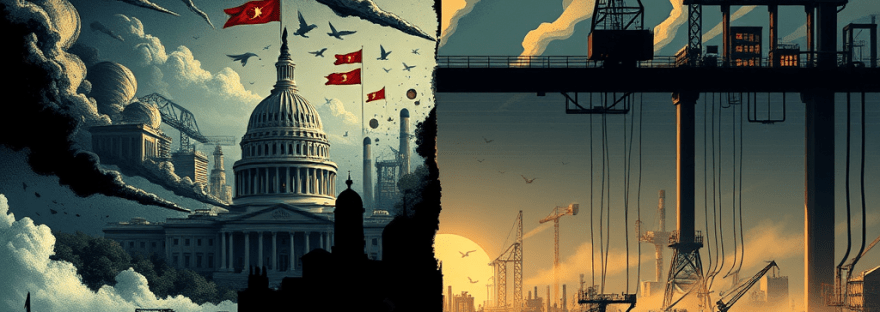
Despite deep political polarization in America, there’s one point where most people across the spectrum agree: something went seriously wrong with the U.S. economy over the past 60 years—and we’re still living with the consequences.
Two Competing Narratives
On the political left, the blame often falls on greed and capitalism. The proposed solution? Raise taxes on the wealthy—both income and investment—and even introduce a wealth tax on unrealized gains. Advocates argue that climate change, driven by unchecked capitalism, is intensifying economic inequality, and that massive redistribution can solve both economic and environmental challenges.
On the political right, the dominant narrative focuses on globalization. As articulated by former U.S. Trade Representative Robert Lighthizer, the shift toward “hyper-globalization” hollowed out American manufacturing and weakened the social fabric. Communities that once housed workers of all income levels became fragmented. The numbers support this: U.S. manufacturing output has grown just 4.3% total over 25 years, barely 0.2% per year. Some industries, like shipbuilding, now rely on government contracts just to survive.
The Overlooked Culprit: Government Growth
Both narratives identify symptoms, but not the root cause. The real issue—rarely discussed—is the explosive growth of the federal government.
In the 1950s, non-defense federal spending made up just 7% of GDP. That rose to 10% in the 1960s, then 14% in the 1970s, where it stabilized through 2000. But since then, it has surged again. In the 2020s, non-defense spending now averages 23% of GDP—more than triple its post-WWII share.
When government grows, the private sector shrinks. Every dollar spent by the government is a dollar not spent or invested by the private economy. If you include state and local government spending—and the costs of regulation—government now directs or restricts over 50% of total U.S. output.
This expansion helps explain the decline in saving rates, rising housing unaffordability, offshoring of manufacturing, and sluggish GDP growth.
We Haven’t Abandoned Capitalism—We’ve Dismantled It
In many ways, the U.S. has already moved away from true capitalism. More government spending or more protectionism won’t solve the problem—they’ll make it worse. The only path to sustainable, long-term economic health is shrinking the size and reach of government.
Yes, it would be disruptive in the short term. But it would directly address the cause of our economic challenges, not just the symptoms. If the federal government downsized and restored fiscal discipline, there’s enormous upside potential for growth, productivity, and prosperity.
It’s time to stop blaming the system—and start fixing what really broke it.
Discover more from FPA Owner Transitions
Subscribe to get the latest posts sent to your email.

 FPA Owner Transitions